- Adspire
- Posts
- The Data Detox
The Data Detox
🤩 When you stop letting dashboards tell you who you are, The new era of social strategy, and more!

Welcome to Adspire, where every edition delivers insights, strategies, and inspiration to fuel your advertising brilliance. 🤯
Just a quick heads-up! If you stumbled upon us through a friend, make sure to subscribe here! That way, you’ll never miss out on the edition
🤩The Data Detox
Marketers used to trust their gut. Now they trust dashboards.
Every campaign is born in a spreadsheet, validated by a graph, and buried by a metric. CTRs and CPCs have replaced creative instinct as the compass for what “works.” But what happens when you unplug for 30 days? No dashboards. No reports. No comforting refresh.
Would your ideas fall apart, or finally come alive?
Because sometimes, the only way to remember how to make people feel something is to stop trying to measure everything.
That’s the idea behind Stack Influence, the platform helping brands replace paid metrics with human proof, turning real customers into micro-influencers whose stories generate organic demand. You can see how it works here.
The Addiction to Control
Data isn’t the addiction; control is.
Numbers give us certainty, even when they’re empty. Dashboards whisper comfort: you’re doing fine, look at the line inching upward. It’s how teams avoid asking scarier questions like, “Is this actually good?”
But the more we rely on numbers to validate creativity, the safer we become, and the safer we become, the more invisible our ideas get.
Here’s the trade-off:
Every time you pick data over instinct, you lose a sliver of originality.
Every test that fails trains you to play smaller next time.
Every dashboard win makes you forget how to spot real resonance.
The 30-Day Fast
Picture it: no metrics for a month.
Instead of checking dashboards, your team watches how people react. What do they comment on? What gets saved? What makes them stop mid-scroll?
By week two, something shifts.
Meetings start to sound different.
“What if this ad actually made someone laugh?”
“Would you send this to a friend?”
“Does this feel like us?”
It’s uncomfortable at first, then freeing. You start to realize that instincts, when given room to breathe, are a better guide than numbers pretending to be the truth.
When You Turn the Data Back On
After the detox, the numbers don’t define the work anymore; they describe it. They’re no longer the driver; they’re the reflection. You read metrics with empathy instead of anxiety. You can finally see what the numbers are saying, not just what they’re showing.
Because real marketing isn’t about mastering analytics; it’s about understanding people, and that understanding only returns when you go quiet long enough to hear it.
TOGETHER WITH SEMRUSH
U.S. ecommerce just rewrote its playbook. Here's what changed.

Semrush and Statista just released data on U.S. ecommerce. And wow. The landscape looks way different from what it did 18 months ago.
Here's what shifted:
• Asian platforms lost 25% of traffic to tariffs. Domestic retailers scooped it up.
• AI assistants now send 35X more shoppers to ecommerce sites
• Paid search jumped 76% YOY, delivering the highest ROI across all channels
The report shows growing categories, top AI traffic sources, state-by-state patterns, and best-converting CTAs.
Download Rewriting the U.S. Ecommerce Playbook to see what these shifts mean for your marketing strategy.
📈 Inside the Future of Social Marketing
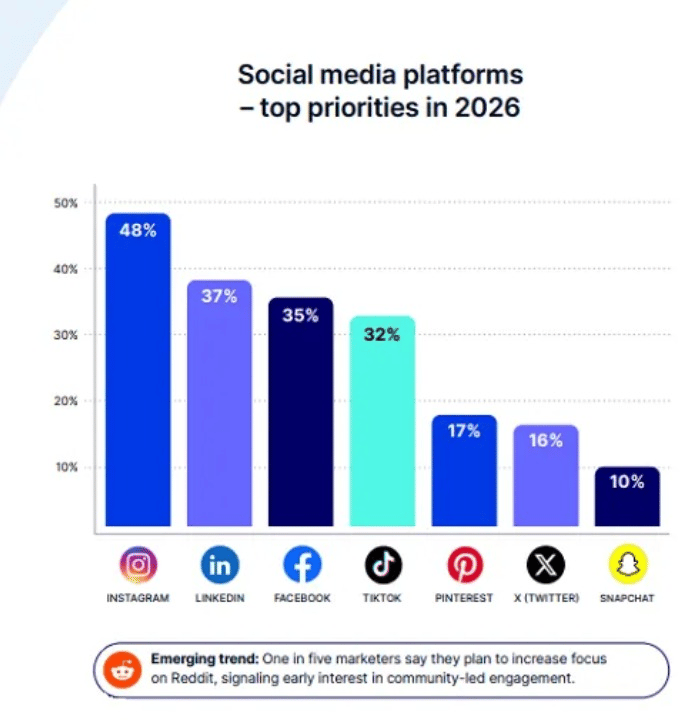
Marketers are heading into 2026 blending AI, creator partnerships, and community-led engagement. The Emplifi report highlights how these shifts are redefining performance priorities across major social platforms.
The Breakdown:
1. AI Integration - 82% of marketers now use AI, mainly for analytics (30%), content creation (28%), and ad targeting (26%). Only 35% report major productivity gains, signaling unrealized potential. Instagram (48 %) and LinkedIn (37%) remain the top AI-driven focus platforms.
2. Influencer Growth - 67% plan to boost influencer budgets in 2026, with micro and macro creators (47% each) leading impact. Campaigns focus on brand awareness (70%) and community growth (49%). 65% of consumers say relatable creators drive their purchase decisions.
3. UGC Expansion - 82% of marketers value UGC, but only 31% scale it effectively due to quality and ROI measurement gaps. With 30% citing content sourcing as the main challenge and 24% struggling to track returns, brands are turning to structured UGC, campaigns (28%), influencer UGC (25%), and customer videos (23%).
4. Platforms and Formats Rebalance Power - Instagram (48%) leads storytelling, LinkedIn (37%) drives thought leadership, and TikTok (32%) fuels discovery and authenticity. Short-form video (73%) dominates, performing best when it is fast and authentic.
The key theme for 2026 is diversification. As marketers spread efforts across platforms, automation, AI scheduling, and analytics ensure efficiency without burnout. Success will depend on tailoring short-form storytelling to each platform rather than cross-posting identical content.
🎥Reel of the Day

What works:
1. The product becomes the protagonist - Ona isn’t presented as a bag, she’s a character with chapters, emotions, and agency. By anthropomorphizing the product, Ölend transforms function into personality, giving the brand a mythos marketers rarely build in short-form content. Stop describing your product, narrativize it.
2. Typography as emotional scaffolding - The serif font and “Chapter” structure evoke a tactile editorial world, borrowing cues from print design and film credits. This positions the brand closer to heritage craft than DTC hype. Typography isn’t decoration, it’s narrative tone. Match font choice to brand soul.
3. Meta-structure that builds ritual, not randomness - Four “Chapters” (Adventurer, Knot, Lightness, Family) aren’t just aesthetic, they create a ritual arc: identity → design → ethos → community. It turns a 40-second video into a myth cycle. Build story architecture, viewers remember progression, not products.
This reel works because it refuses to play by social media’s rules. It slows time, makes product a person, and elevates craft to cinema. the lesson is simple: stop optimizing for scroll velocity, start designing for mythic memory.
Thanks for reading this edition of Adspire! Keep pushing boundaries, testing ideas, and staying inspired. See you in the next issue with more ways to ignite your marketing success!