- Adspire
- Posts
- Owning Your AI Reputation
Owning Your AI Reputation
Negative AI anchors are killing intent long before customers click, and more!

Welcome to Adspire, where every edition delivers insights, strategies, and inspiration to fuel your advertising brilliance. 🤯
Just a quick heads-up! If you stumbled upon us through a friend, make sure to subscribe here! That way, you’ll never miss out on the edition
🪞Owning Your AI Reputation
Marketers are entering a new battlefield: AI-powered answers. Unlike search engines, where you can optimize titles and backlinks, AI systems (ChatGPT, Google AI, Perplexity, Gemini) generate answers that “lock in” brand perceptions over time.
If a flawed anchor like “too expensive” or “low trust” shows up in those responses, it can quietly calcify into consumer belief before you even see it.
This isn’t a vanity issue. It’s a revenue issue. Negative anchors shape purchase intent long before a visitor lands on your site or sees an ad.
The challenge is that by the time your team notices, the damage has already spread across customer queries, reviews, and competitor narratives.
Why Perception Anchors Form
AI models don’t invent bias from nowhere. They pull from three places:
Customer-generated chatter → Reviews, forums, social mentions. If negative sentiment dominates, it feeds directly into AI outputs.
Competitor positioning → If rivals consistently frame themselves as the “affordable alternative,” models echo the contrast.
Outdated brand content → Old PR, abandoned blogs, or early campaign language that’s still floating in the index.
These fragments become sticky anchors. And once they’re repeated by AI systems, they influence everything from top-of-funnel awareness to conversion lift on retargeting ads.
The New Playbook: Monitor, Diagnose, Correct
The solution isn’t throwing more content into the void. It’s about engineering your reputation the same way you manage spend or supply chains.
1. Track your AI footprint: Use the SEMrush AI SEO Toolkit to see exactly how your brand is being described across AI platforms. If “overpriced” or “bad support” shows up in answers, you’ll spot it before it spreads. You can sign up today for the 14 days free trial and start tracking your AI visibility, prompt-by-prompt.
2. Classify the anchors: Not all mentions are toxic. Some are neutral but incomplete (“mid-market skincare brand”), while others are damaging. Classify them into:
Corrective → Needs urgent action (false claims, negative pricing frames).
Amplify → Positive but underrepresented (trust, expertise, community).
Neutral → Can be reshaped with stronger storytelling.
3. Correct with precision
Anchor correction doesn’t mean flooding the web with generic PR. Instead:
Launch proof-heavy assets (case studies, testimonials, analyst quotes) targeted at the exact claims.
Refresh owned properties so old language stops feeding the models.
Build third-party signals via reviews, interviews, and features that outweigh competitor noise.
Why This Matters Right Now
Q4 and Q1 are the seasons when marketers are under the heaviest scrutiny. Budgets are closing, new ones are opening, and leadership wants proof that positioning is airtight.
Allowing AI anchors to drift negative during this cycle isn’t just risky, it’s compounding damage at the worst possible time.
Owning your AI reputation isn’t optional anymore. It’s the hidden lever that shapes customer perception before your funnel even begins. Monitor it, reshape it, and treat it like the new frontier of brand equity.
TOGETHER WITH INSENSE
1 UGC creator = 20+ ad variations to scale your Q4 creative testing

Insense makes UGC ads insanely cost-effective.
From one brief, get numerous raw footage clips to mix, match, and turn into multiple scroll-stopping creatives for your paid social ads.
Source 20+ pieces of raw content (per creator) with lifetime usage rights, all delivered in 14 days or less.
That’s how 2000+ brands like Beauty Pie, Bones Coffee, Flo Health, and Aceable scale UGC without killing team bandwidth.
Cost-effective UGC with lifetime usage rights? Yes please!!
🏷️ Americans Want AI Transparency but Stay Skeptical
A new Pew Research survey highlights that while many Americans welcome AI in certain tasks, they strongly want transparency and control over where it’s used.
The Breakdown:
1. People Want More Control - About 60% of Americans want more control over AI in their lives, up from 55% last year. Seventy-six percent say it’s extremely or very important to know whether pictures, videos, or text were made by AI or by people, yet only 12% feel confident they could tell the difference themselves.
2. Where People Accept vs. Reject AI - Most support AI in data-intensive areas like weather prediction, fraud detection, and drug development. But about two-thirds oppose AI in personal domains such as religious guidance and matchmaking.
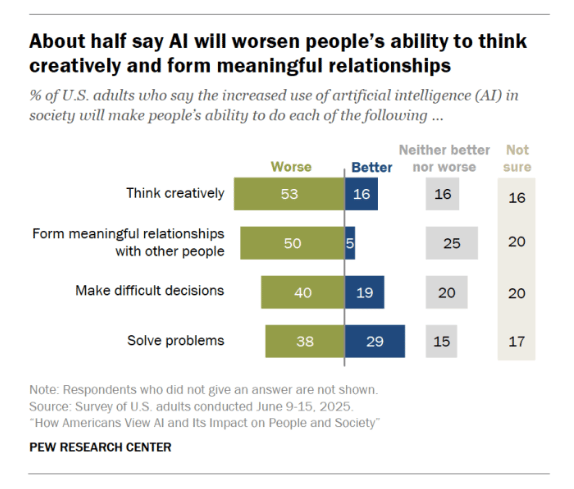
3. Younger Audiences Are More Aware - Awareness of AI is highest among adults under 30, with 62% saying they’ve heard a lot about it, compared to only 32% of those 65 and older. Yet younger adults are also more likely to believe AI will harm creative thinking and meaningful human relationships.
Over half of Americans fear AI will weaken creativity and human connection, and they want transparency when AI is used. Brands that clearly label AI involvement and show human input can build trust and stand out with audiences who value openness.
🎥Reel of the Day


What Works and Insights:
1. Guerrilla-Style Storytelling - The chaotic “wtf this dude doing” phone-shot opener instantly breaks the polished-ad pattern and feels like a viral street moment. Viewers lean in because it feels unscripted and unpredictable, not staged. Brands can seed raw, phone-captured intros to spark curiosity before any reveal, creating organic virality.
2. Chase-to-Reveal Structure - The running, fence-jumping sequence builds suspense before the logo payoff. This physical action doubles as a moving transition, making the brand reveal feel earned and cinematic. Use motion-driven suspense to hold viewers until a final branded drop for higher retention.
3. Packaging as a Hero Prop - The Sapien bag isn’t just a product wrapper, it’s the narrative anchor. Dropped, grabbed, flipped, and held to camera, it transforms into a symbol of exclusivity and speed. Turn everyday packaging into a story object so the product itself drives the plot.
By fusing user-generated chaos with a deliberate brand payoff, this reel proves that low-fi energy can heighten exclusivity and make a drop feel like an event.
Thanks for reading this edition of Adspire! Keep pushing boundaries, testing ideas, and staying inspired. See you in the next issue with more ways to ignite your marketing success!